HZO based FeFET with Sub 2-nm EOT Gate Stack as Synapse for Spiking Neural Network
Jaskirat Singh Maskeen, Apu Das, Gautham Kumar, and 9 more authors
In 2025 IEEE 7th International Conference on Emerging Electronics (ICEE), Dec 2025
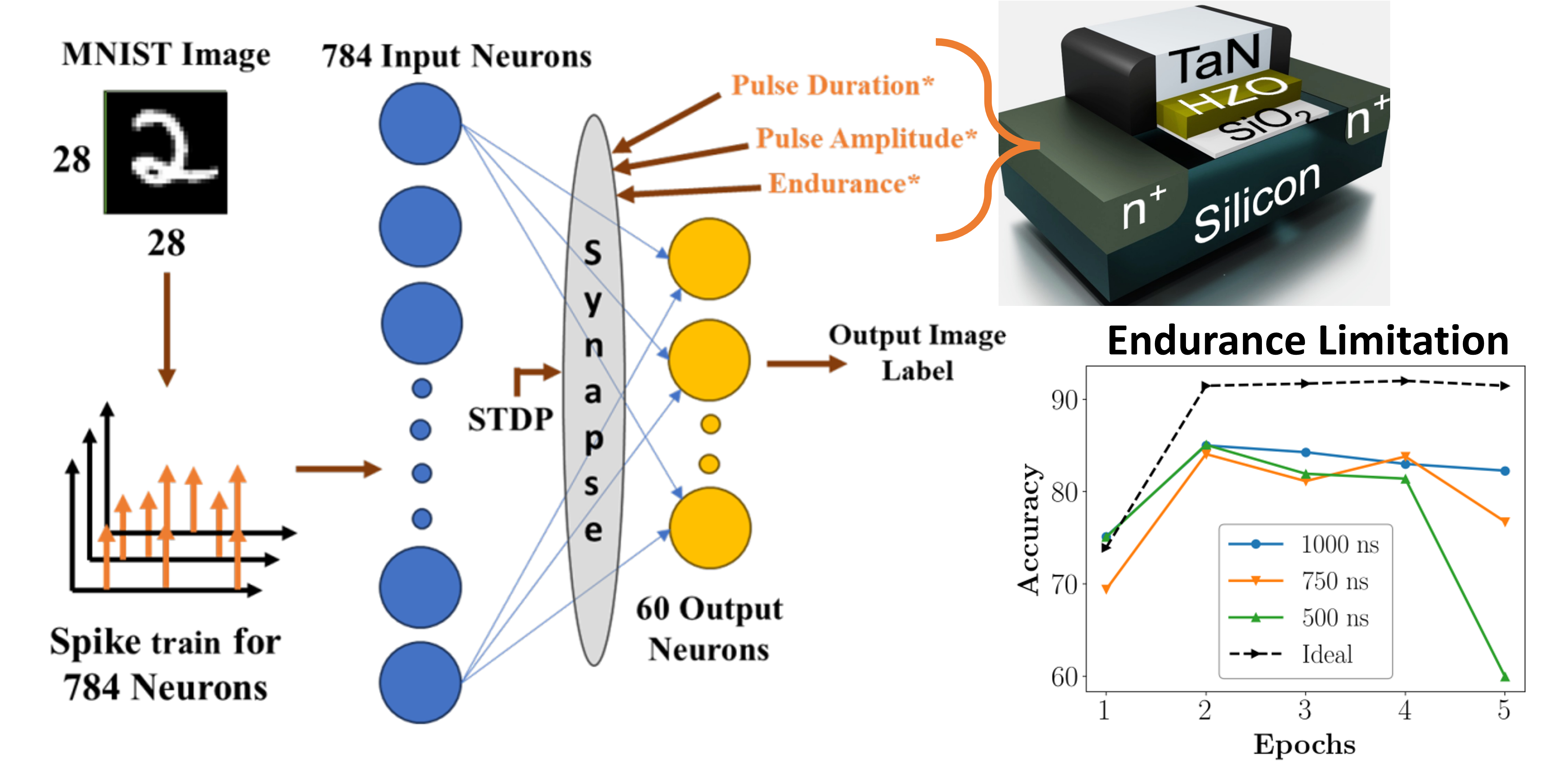
Ferroelectric FET (FeFET) synapses based on HZO with a sub-2 nm EOT gate stack promise dense, low-power neuromorphic hardware. Yet, their system efficacy is tightly coupled to the particulars of device-level electrical characterization. In this work, we establish a quantitative device-to-algorithm link by evaluating how standard measurement controls such as program/erase pulse amplitude, pulse duration, and cycling endurance, shape the FeFET memory window, weight uniformity and, in turn, impact spiking neural network (SNN) performance. Using experimentally measured transfer characteristics and pulse responses, we show that reductions in memory window and increased update non-uniformity induced by sub-optimal pulse conditions directly constrain the attainable weight range and weight-change linearity, degrading accuracy and stability during SNN training/inference. We map the feasible operating envelope that jointly maximizes memory window, monotonicity, and endurance, and translate it into actionable pulse-engineering guidelines (amplitude-width co-tuning and endurance-aware programming schedules) for synaptic updates. By closing the loop from metrology to application, this study provides a systematic methodology to co-optimize FeFET electrical characterization and SNN performance, offering practical screening criteria for wafer-level device selection and a pathway to reproducible, deployment-grade neuromorphic systems with sub-2 nm-stack FeFET synapses.